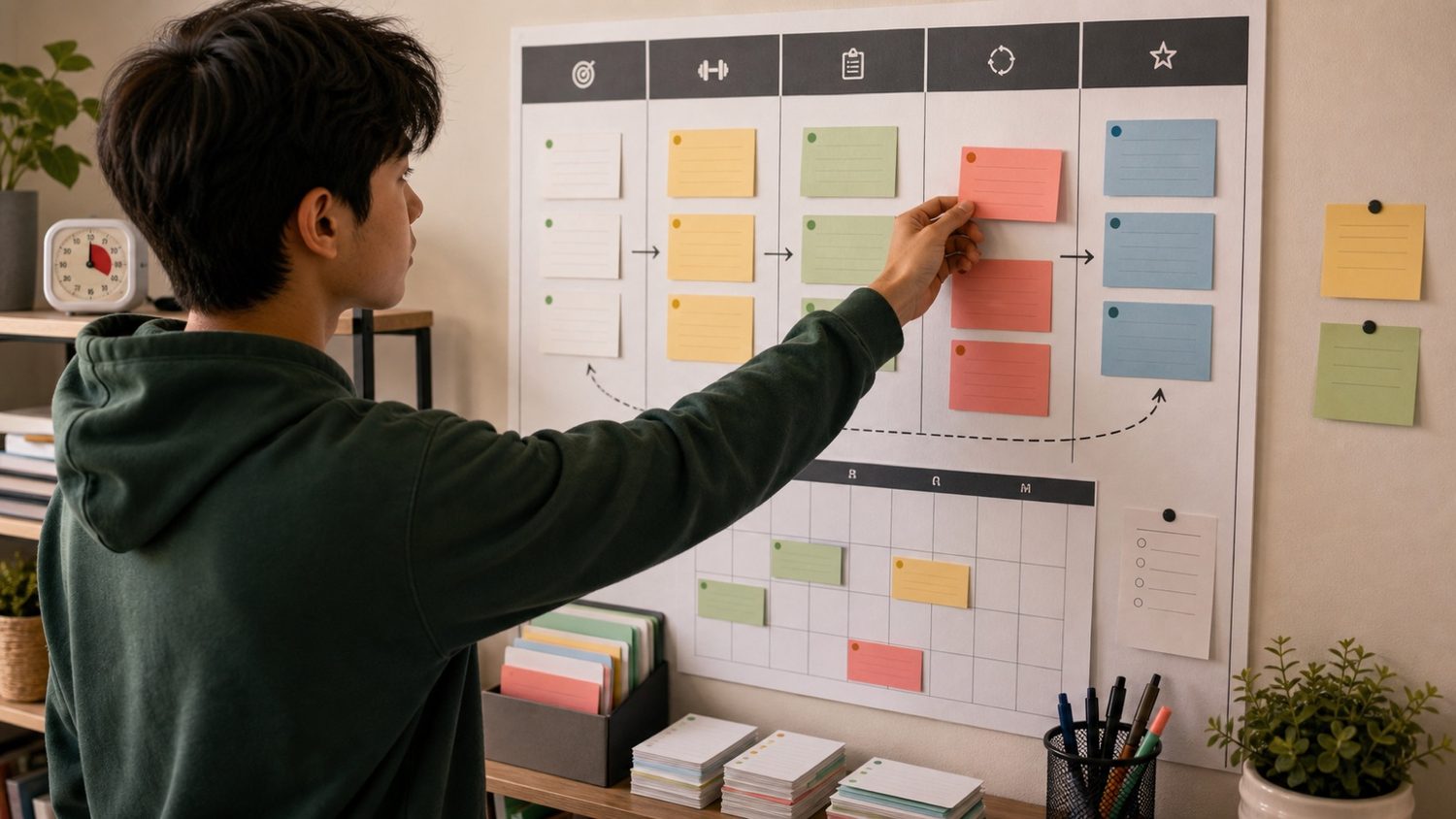
Make the study plan realistic
Use the exam date, syllabus, available time, and weak areas to create a plan that can survive real life.
Open step
Build an AI exam prep workflow with a realistic study plan, retrieval practice, quizzes, flashcards, and weak-area review.
Get a study schedule, quiz yourself on weak areas, and turn misses into flashcards for repeated review.
Each step opens a live guest mode, so this is not a static guide. It is a route into practice, feedback, and review.
Use the exam date, syllabus, available time, and weak areas to create a plan that can survive real life.
Open stepQuiz yourself first so you can see what you actually remember and where confidence is misleading.
Open stepMake flashcards from errors, hesitation, formulas, definitions, and concepts you could not explain clearly.
Open stepThese guest modes open directly, so you can start practising without needing a saved private chat.
These are written to make the AI coach, question, and review rather than simply produce an answer to copy.
My exam is on this date. Here is the syllabus, my weak areas, and my available time. Make a realistic plan with daily recall.
Open modeExample promptQuiz weak areasQuiz me on these topics one question at a time. After each answer, explain the gap and increase difficulty slowly.
Open modeExample promptConvert missesTurn these missed questions into flashcards grouped by concept, formula, definition, and example.
Open modeThe point is not to use AI less. It is to use it in a way that leaves you with stronger understanding after the session.
Do not make a plan that assumes every topic needs equal time.
Do not reread notes before testing what you can already recall.
Do not ignore hesitation; uncertainty is a useful signal for review.
A good path does not end at the answer. It ends with a test, a correction, and a next repetition.
Start each session with a quick quiz before rereading.
Continue loopAsk for a simpler explanation of the weakest concept.
Continue loopMake flashcards from errors and revisit them after a delay.
Continue loopThe blog supports the path with prompts, study strategy, and examples that link back into live modes.
Each phrase maps to the same practical workflow: choose a public mode, ask for active help, then review what changed.
Start as soon as you know the exam date. If time is short, prioritize weak areas, past-paper style questions, and daily recall.
Quizzes usually reveal more because they test retrieval. Rereading can help after a quiz shows what needs repair.